

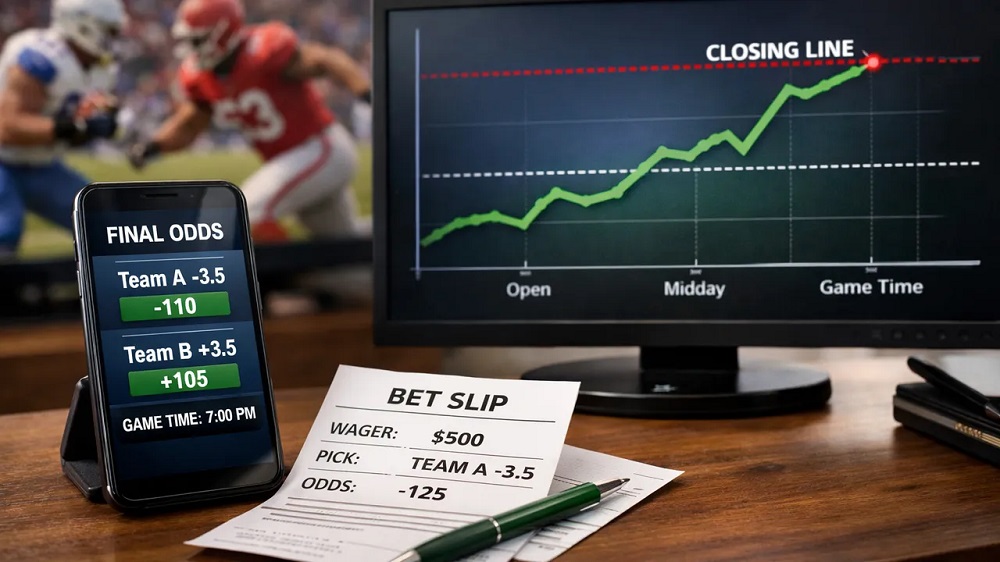
Sports betting is often viewed as a game of predicting outcomes. Casual bettors spend hours analyzing team statistics, injury reports, and weather conditions to guess who will win a game. However, professional sports bettors view the market differently. They treat sports betting like a financial market, where the goal is not just to predict the winner, but to buy an asset at the best possible price.
In sports betting, the price of your asset is the point spread, moneyline odds, or point total you lock in when you place a wager. To determine whether you made a good investment, you must measure your ticket against the final price offered before the game starts. This concept is known as Closing Line Value. Understanding and consistently achieving this metric is the single most reliable indicator of long-term profitability in sports betting.
What is Closing Line Value
Closing Line Value represents the difference between the odds or point spread a bettor locked in and the final, official odds offered by the sportsbook right before the event begins. The closing line is widely considered the most efficient and accurate representation of a game’s true probability because it incorporates all available information, sharp bettor consensus, and massive amounts of market liquidity up to the absolute last second.
If you place a bet at a better price than the final closing line, you have generated positive value. If the line moves against you, and the final price is better than what you accepted, you have generated negative value.
The Mechanics of Line Movement
To understand how value is created, it helps to look at why lines move in the first place. Sportsbooks open a betting market by posting an initial line, known as the opening line. This opening number is an educated estimate based on historical data and predictive algorithms.
Once the line is open to the public, bettors begin placing wagers.
-
Public Money: Large volumes of casual wagers can shift lines, though sportsbooks often resist moving lines purely based on public bias unless the volume is overwhelming.
-
Sharp Action: Respected, high-stakes bettors place large wagers on a specific side. Sportsbooks respect this opinion and immediately shift the line to minimize their risk and adjust to the sharp insight.
-
Breaking News: Late-breaking information regarding player injuries, suspensions, or sudden weather shifts will cause sportsbooks to manually adjust the lines across the entire market.
As these factors interact throughout the week or day leading up to a game, the line fluctuates. The point at which these fluctuations stop—right as the game kicks off or tips off—is the closing line.
The Mathematics Behind the Value
The concept of value is not just theoretical. It can be mathematically proven using standard probability calculations. When you beat the closing line, you are essentially buying a product at a discount, which shifts the mathematical house edge back in your favor.
Consider an NFL point spread example:
-
You bet on the Kansas City Chiefs at -3.
-
Throughout the week, heavy sharp action comes in on the Chiefs.
-
By kickoff, the line closes at Chiefs -4.5.
By getting the Chiefs at -3, you have captured significant value. You win your bet if the Chiefs win by 4 points, whereas anyone who bet the closing line of -4.5 loses their wager in that exact scenario.
To calculate the exact financial impact of this movement on moneylines, bettors use implied probability. The formula to convert American negative moneyline odds into implied probability is:
If you bet a team at -110, the implied probability required to break even is $52.38\%$. If the market moves and that same team closes at -130, the new implied probability jumps to $56.52\%$. By locking in -110, you secured an asset that the mature market deems to be worth $56.52\%$ for a price that only requires a $52.38\%$ success rate. Over hundreds of wagers, this discrepancy represents the entire margin between losing your bankroll and making a substantial profit.
Why the Closing Line is Highly Efficient
The concept relies heavily on the Efficient Market Hypothesis, a financial theory stating that asset prices reflect all available information. The sports betting market behaves similarly.
When a betting line opens, the market is relatively inefficient. Only a small group of analysts have weighed in, and betting limits are typically low, which deters high-volume syndicates from exposing their models. As the week progresses, limits rise, and more participants enter the market.
Every bet placed acts as a piece of data. If a line is incorrect, sharp bettors will exploit it by betting heavy sums, forcing the sportsbook to correct the number. By the time a game is minutes away from starting, millions of dollars have tested the validity of the line. The resulting closing line represents a highly accurate consensus opinion of the true baseline probability of the matchup. It is incredibly difficult to beat this mature line consistently over time, which is why your goal should be to beat it before it matures.
Strategies for Consistently Beating the Line
Generating consistent positive value requires discipline, timing, and a deep understanding of market behavior. It shifts your focus away from handicapping teams and toward handicapping the actual market numbers.
Line Shopping Across Multiple Sportsbooks
The simplest way to capture value is to maintain active accounts at several different sportsbooks. Sportsbooks do not always move their lines simultaneously. When a sharp group hits a line at one major book, that book will shift its number immediately. Other sportsbooks, known as downstream books, may take several minutes to adjust their lines to match the market leaders.
By monitoring multiple sportsbooks, you can find a book that is slow to react to market adjustments, allowing you to lock in the old, superior number before it vanishes.
Timing Your Wagers
Understanding market cycles dictates when you should place your bets.
-
Betting Favorites and Over Totals Early: Casual bettors overwhelmingly prefer to bet on favorite teams and high-scoring games. Because of this predictable public bias, lines for favorites and over totals tend to become more expensive as kickoff approaches. If you like a favorite, betting them early in the week often yields the best value.
-
Betting Underdogs and Under Totals Late: Conversely, lines for underdogs and under totals often improve as the week goes on because public money artificially inflates the line for the favorite. Waiting until right before game time often allows you to secure extra points or better odds on an underdog.
Originating Personal Power Ratings
To beat the sportsbooks to the punch, you must have an established opinion on what the line should be before it opens. Advanced bettors build quantitative models to create their own power ratings. If your model suggests a game should be priced at -6, and the sportsbook opens the line at -4, you instantly recognize an inefficiency and can place your bet before the rest of the market forces the line up to -6.
Measuring and Tracking Success
If you want to know whether you are an excellent sports bettor, stop looking at your short-term win-loss record. Due to variance, a terrible bettor can go on a hot streak and win $65\%$ of their bets over a two-week span. Conversely, a brilliant professional can go on a cold streak and lose money over fifty wagers.
Instead, track the percentage of time you generate positive value over a sample size of 500 or more bets.
If you are beating the closing line on more than $60\%$ of your wagers, you are mathematically guaranteed to be a profitable long-term bettor, regardless of what a brief run of bad luck might show in your bankroll account.
Pitfalls and Misconceptions
While tracking this metric is vital, bettors often fall victim to several common misconceptions that can distort their data and strategies.
Confusing Outright Wins with Value
Beating the line does not mean every individual bet will win. You can bet a team at +7, watch the line close at +4, and still lose the bet if that team loses by ten points. This outcome does not mean your bet was bad. You made a mathematically sound investment that will yield a high return over hundreds of identical situations. Do not alter a successful strategy based on the random variance of single-game outcomes.
Overestimating Meaningless Line Movement
Not all line movement is created equal. Moving from a point spread of -10.5 to -11 is mathematically insignificant because very few football games land precisely on a margin of 11 points. However, moving from -2.5 to -3.5 is massive because 3 is the most common margin of victory in NFL history. Beating the line across a key number carries exponentially more weight than beating a line across dead numbers.
Frequently Asked Questions
Does closing line value matter for live betting markets?
Live betting, or in-game wagering, operates under different market mechanics. Because lines adjust in real-time based on immediate play-by-play events, there is no traditional closing line to measure against. Instead, value in live betting is found by exploiting algorithmic delays or recognizing structural changes in momentum before the sportsbook’s software adjusts.
Why do some sportsbooks ban or limit bettors who consistently beat the line?
Sportsbooks operate on profit margins. When a bettor consistently places wagers that beat the closing line, it proves that the bettor is skilled at identifying market inefficiencies before the book can correct them. Over time, these bettors drain liquidity from the sportsbook, causing risk management teams to place personal limits on how much that specific account can wager.
How does market liquidity affect the reliability of the closing line?
Market liquidity refers to the total volume of money being wagered on an event. High liquidity markets, such as premier soccer leagues or the NFL, draw massive betting volume, making their closing lines incredibly efficient and accurate. Low liquidity markets, like small college sports or obscure international leagues, can have closing lines that are still highly inefficient because not enough sharp money has entered to correct the numbers.
Can a bettor still make a profit without beating the closing line?
It is technically possible but mathematically improbable over an extended timeline. If you consistently place bets at the exact closing line, you are paying the full house tax, known as the juice or vig. To overcome this fee without any market advantage, your sports analysis models must be significantly more accurate than the combined consensus of the global betting market, which is incredibly rare.
Does closing line value carry the same weight in player prop markets?
Yes, the concept applies directly to player props, such as over or under a specific player’s total passing yards. In fact, prop markets open with much lower limits and are far more volatile than main game lines. This means large discrepancies often exist early in the day, allowing sharp eyes to secure massive value before the market stabilizes near game time.
What should I do if the line moves heavily against my bet after I place it?
If a line moves against you, it indicates that new information has entered the market or a significant wave of sharp money backed the opposing side. You should avoid panic-betting the other side to cancel out your wager, as this will result in paying the sportsbook tax twice. Accept the negative value as an isolated incident, analyze whether you missed a piece of data before betting, and look ahead to the next opportunity.